
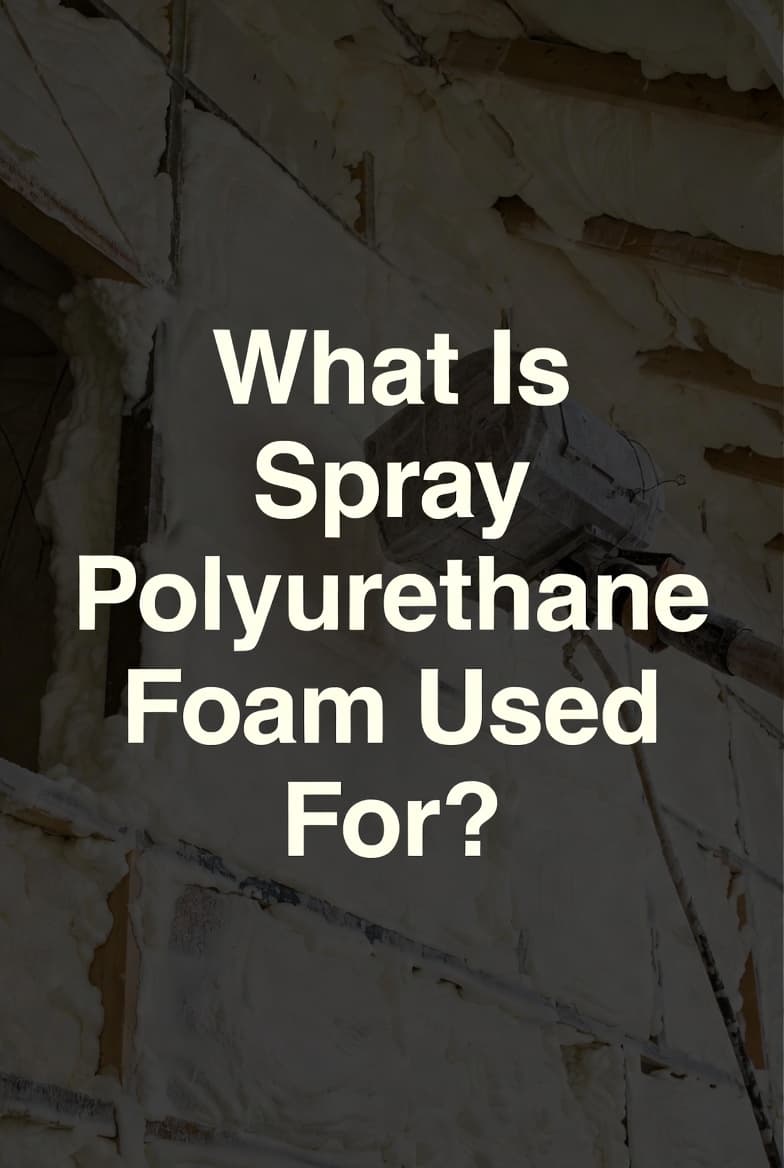
What Is Spray Polyurethane Foam Used For? (2026)
Spray polyurethane foam (SPF) is one of the most versatile construction and industrial materials available today. If you've ever wondered what it's used for — beyond just plugging gaps around a window frame — this guide gives you the complete picture, from residential insulation to commercial roofing, marine flotation, and industrial waterproofing.
The short answer: Spray polyurethane foam is used for building insulation, air sealing, roofing, waterproofing, sound control, structural reinforcement, cold storage, and dozens of industrial and marine applications. Its ability to expand up to 120 times its liquid volume and bond to almost any surface makes it uniquely suited for jobs that no other single material can handle.
Read on for a full breakdown of every major application, expert perspectives, current cost data, and guidance on which type of SPF is right for each use.
Table of Contents
- What Is Spray Polyurethane Foam?
- The Two Types of SPF: Open-Cell vs. Closed-Cell
- Building Insulation
- Air Sealing and Vapor Barriers
- Roofing Systems
- Waterproofing and Moisture Control
- Sound Dampening and Acoustics
- Structural Reinforcement
- Cold Storage and Refrigeration Facilities
- Industrial and Commercial Uses
- Marine Applications
- Agricultural Applications
- How Long Does SPF Last?
- Cost Considerations
- How to Choose the Right SPF for Your Project
- FAQ
What Is Spray Polyurethane Foam?
Spray polyurethane foam is a two-component liquid system — Part A (isocyanate) and Part B (polyol resin) — that combine at the spray gun tip and react instantly on contact with a surface. Within seconds, the liquid expands up to 30–120 times its original volume, forming a rigid or semi-rigid foam that bonds directly to the substrate.
The U.S. Environmental Protection Agency (EPA) classifies SPF as both an insulation material and an air barrier system — making it one of the few single-product solutions that simultaneously addresses thermal performance, air infiltration, and moisture control.
Key properties of spray polyurethane foam:
- Expands to fill irregular cavities, voids, and penetrations completely
- Bonds to wood, metal, concrete, masonry, fiberglass, and most substrates
- Creates a seamless, continuous air and thermal barrier
- Available in open-cell (soft, lower density) and closed-cell (rigid, higher density) formulations
- R-values range from R-3.5 per inch (open-cell) to R-6.5 per inch (closed-cell)
- Closed-cell SPF adds meaningful structural rigidity to assemblies it is applied to
The Two Types of SPF: Open-Cell vs. Closed-Cell
Understanding the difference between open-cell and closed-cell SPF is essential before evaluating any application. Choosing the wrong formulation for a given use case leads to poor performance, moisture problems, or unnecessary expense.
Open-Cell Spray Foam
Open-cell SPF has a soft, spongy texture because its cells are intentionally left "open" — air fills the interconnected spaces between cells. This gives it excellent sound absorption and a significantly lower material cost than closed-cell foam.
- Density: ~0.5 lb per cubic foot
- R-value: ~R-3.5 per inch
- Best for: Interior walls, sound control, vented attic floors, budget-sensitive projects
- Not appropriate for: Below-grade applications, roofing, high-moisture or vapor-sensitive assemblies
Closed-Cell Spray Foam
Closed-cell SPF has cells that are completely sealed and filled with a low-conductivity gas, giving it superior thermal performance, compressive strength, and moisture resistance. At 2+ inches thick, it qualifies as a Class II vapor retarder under the International Building Code.
- Density: ~2 lb per cubic foot
- R-value: ~R-6 to R-6.5 per inch
- Best for: Roofs, crawl spaces, exterior walls, below-grade surfaces, flood zones, cold storage, marine applications
- Advantage: Functions simultaneously as insulation, air barrier, and vapor retarder — and adds structural strength to wall assemblies
Expert perspective: The Spray Polyurethane Foam Alliance (SPFA) identifies specifying the wrong foam type for a given climate zone or exposure condition as the most common cause of SPF performance problems in the field. Always consult a certified contractor before specifying either product for a code-compliance application.
Building Insulation
The most widespread use of spray polyurethane foam is thermal insulation in residential and commercial construction. Unlike fiberglass batts or blown-in cellulose — which settle over time and leave gaps at penetrations and framing edges — SPF expands to form a seamless, continuous thermal envelope that maintains its performance for the life of the building.
Attics and Roof Decks
Closed-cell foam applied directly to the underside of roof sheathing creates an unvented attic assembly, moving the building's thermal boundary from the attic floor up to the roof line. This keeps HVAC ductwork within conditioned space — a critical benefit since duct leakage in an unconditioned attic can reduce system efficiency by 20–30%, according to research from Oak Ridge National Laboratory.
Unvented attic assemblies insulated with SPF also reduce whole-house cooling loads significantly compared to vented attics with blown-in insulation, particularly in hot-humid climate zones where air infiltration carries moisture as well as heat.
Exterior Walls
SPF in stud cavities eliminates thermal bridging through wood framing members — a phenomenon that reduces the effective R-value of a standard fiberglass-insulated wall by 15–25% because the wood conducts heat far more readily than the insulation itself. Closed-cell foam also increases wall racking resistance.
Basement Walls and Rim Joists
The rim joist — the framing member at the top of the foundation wall — accounts for as much as 15% of total air leakage in a typical home, according to the Department of Energy. Its irregular geometry makes it one of the most difficult areas to insulate with conventional materials. Closed-cell SPF applied directly to the rim joist simultaneously insulates and air-seals in a single step with no additional materials, making it the most cost-effective rim joist solution available.
Crawl Spaces
Encapsulated crawl spaces using closed-cell foam on foundation walls and band joists dramatically reduce moisture infiltration, mold risk, and floor-to-floor heat loss. A properly encapsulated crawl space also raises floor temperatures in winter, improving comfort in rooms directly above.
Cathedral Ceilings
Where no attic space exists above finished living areas, SPF fills rafter bays completely — eliminating the ventilation gap that would otherwise be required — providing maximum R-value in a minimum thickness. In many retrofit scenarios, this is the only practical path to achieving code-required insulation levels in cathedral ceiling assemblies.
Energy Performance Reality Check
A closed-cell SPF wall assembly at R-20 can perform comparably to a fiberglass-insulated wall at R-30 because of SPF's near-zero air infiltration rate. Air movement transports heat 10–50 times more efficiently than conduction through insulation — stopping it at the source is more effective than simply adding R-value on paper.
Air Sealing and Vapor Barriers
Air leakage accounts for 25–40% of energy loss in the average American home, according to the Department of Energy. Addressing it is where spray polyurethane foam earns its strongest return on investment.
When applied, SPF expands into every crack, gap, electrical penetration, and pipe sleeve — locations that traditional insulation cannot reach. The result is a monolithic air barrier that dramatically reduces uncontrolled air movement through the building envelope.
Where SPF Seals Air Leaks
- Around rough window and door frame openings
- At top and bottom plates of exterior wall framing
- Between wall cavities and attic spaces (a primary driver of stack-effect air movement)
- Around recessed lighting fixtures (each can leak the equivalent of a 2-inch hole in the ceiling)
- Around plumbing and electrical penetrations through top plates and rim joists
- At the sill plate interface between wood framing and concrete foundations
Vapor Control
Closed-cell SPF at 2 inches or more meets the International Building Code's Class II vapor retarder requirement (≤1.0 perm). This makes it the preferred solution for:
- Cold climates (IECC Climate Zones 5–8) where vapor control on the warm side of insulation is code-required
- Below-grade applications where persistent ground moisture is a concern
- High-humidity environments such as natatoriums, commercial laundries, and food processing facilities
Roofing Systems
Spray polyurethane foam roofing is a mature, well-documented system used on millions of square feet of commercial, institutional, and industrial rooftops across North America. An SPF roof system consists of closed-cell foam sprayed directly onto the existing or new roof substrate, followed by a protective elastomeric coating that shields the foam from UV degradation and weathering.
Why SPF Roofing Outperforms Traditional Systems
- Seamless: No joints, seams, or penetrating fasteners that can open and allow water infiltration over time
- Self-flashing: Foam conforms to every penetration, curb, drain, and HVAC curb — eliminating the flashings that are responsible for the majority of commercial roof leaks
- Lightweight: Adds approximately 2–4 lbs per square foot, well within most existing structural capacity margins
- Renewable: Can be recoated every 10–20 years instead of torn off and sent to a landfill, dramatically reducing lifecycle costs and waste
- High thermal performance: R-6+ per inch reduces cooling loads in large commercial buildings with extensive roof-to-floor area ratios
SPF Roofing Applications
Commercial and industrial buildings: Warehouses, manufacturing plants, big-box retail, office buildings, and schools with flat or low-slope roofs are the primary candidates. SPF roofing becomes especially cost-competitive on buildings over 5,000 square feet, where savings from eliminating tear-off and reducing energy costs offset the higher upfront material cost.
Re-roofing over existing systems: SPF is frequently applied directly over existing built-up roofs (BUR) or single-ply membranes without tear-off, reducing disposal costs and minimizing disruption to building operations during re-roofing.
Cold storage facilities: The combination of seamless application, high R-value, and zero penetrating fasteners makes SPF the preferred roofing choice for temperature-controlled warehouses and food processing facilities.
From the field: The SPFA maintains documentation of functioning SPF roofs originally installed in the early 1970s that remain in service today following periodic recoating — a service life no traditional roofing system has demonstrated at scale.
Waterproofing and Moisture Control
Closed-cell SPF has a water vapor permeance below 1 perm at 2 inches of thickness and absorbs virtually no liquid water by volume — making it one of the most effective below-grade and exposed waterproofing membranes available for construction applications.
Below-Grade Waterproofing
Foundation walls, retaining walls, elevator pits, and below-grade parking structures are commonly coated with closed-cell SPF before backfilling. The foam creates a continuous, void-free waterproof membrane that resists hydrostatic pressure and eliminates the moisture migration that is chronic in unprotected concrete walls.
Pond and Secondary Containment Lining
SPF seals decorative koi ponds, stormwater retention basins, and secondary containment berms around above-ground storage tanks. When topcoated with a UV-stable polyurea or elastomeric coating, it forms a seamless, flexible liner that conforms to any geometry and resists cracking under differential settlement.
Bridge Decks and Civil Infrastructure
State DOTs and civil engineers use SPF to waterproof bridge decks, concrete culverts, tunnel linings, and other infrastructure. The foam fills voids in deteriorating concrete, provides a waterproof layer to new construction, and significantly extends service life by preventing the freeze-thaw damage that is the leading cause of concrete infrastructure failure in northern climates.
Sound Dampening and Acoustics
Open-cell spray polyurethane foam is among the most effective materials for reducing sound transmission between spaces. Its soft, interconnected cell structure absorbs sound energy rather than reflecting it back into the room — a characteristic that rigid insulation materials cannot replicate.
Acoustic Applications
Home theaters and recording studios: Open-cell SPF in walls, ceilings, and floors reduces airborne sound (voices, music) and structure-borne noise (impact transmission) simultaneously, creating the acoustic isolation required for high-fidelity audio environments.
Multi-family housing: Spray foam in floor-ceiling assemblies between apartment units reduces both impact noise (footsteps, dropped objects) and airborne sound more effectively than fiberglass batts, which routinely leave gaps at framing edges that become acoustic flanking paths.
Open-plan offices and healthcare facilities: SPF in interior partition walls provides the speech privacy necessary for HIPAA compliance in clinical settings and general workplace productivity in open-plan environments.
Mechanical rooms: Foam applied around HVAC equipment housings, supply and return duct connections, and pipe penetrations through walls and floors significantly reduces the mechanical noise transmitted to adjacent occupied spaces.
Automotive manufacturing: Automotive-grade two-component foam is sprayed into door cavities, dashboards, floor pans, and roof liners during vehicle assembly as part of NVH (noise, vibration, and harshness) control programs — a standard practice across global automotive OEMs.
Structural Reinforcement
One of the least-discussed but increasingly valued properties of closed-cell SPF is its measurable contribution to the structural performance of building assemblies.
Racking and Shear Resistance
Research published by the SPFA and independent testing laboratories has demonstrated that closed-cell foam in wall cavities increases racking resistance by 200–300% compared to identical uninsulated stud wall assemblies. This has significant implications for:
- Coastal construction in hurricane exposure zones (ASCE 7 wind design categories)
- Seismic design zones where lateral load resistance is a primary code requirement
- Manufactured and modular housing, where wall panel rigidity affects both transportation and field performance
Slab Lifting and Void Filling
Closed-cell SPF is injected beneath settled concrete slabs, driveways, warehouse floors, and roadways to fill voids and hydraulically raise the slab back to grade — a process called polyurethane foam jacking. Compared to traditional mudjacking, foam jacking uses smaller injection holes (5/8" vs. 1.5–2"), adds negligible weight to the substrate, and reaches final elevation within minutes rather than requiring days for a cement slurry to cure.
Hollow Structural Member Filling
In marine, aerospace, and specialty construction, rigid SPF is injected or poured into hollow structural members — box beams, pontoon floats, mast sections — to prevent catastrophic collapse if the outer shell is breached, while simultaneously adding stiffness and vibration damping.
Cold Storage and Refrigeration Facilities
Spray polyurethane foam is the dominant insulation material for refrigerated warehouses, walk-in coolers, blast freezers, and food processing facilities.
Why SPF Dominates Cold Storage
Maximum R-value per inch: In cold storage, wall and ceiling thickness directly affects usable cubic footage. Closed-cell SPF at R-6.5 per inch requires roughly half the wall thickness of EPS board at R-4 per inch to achieve the same thermal resistance — a meaningful difference across thousands of square feet of wall and ceiling area.
No thermal bridging: Metal framing in cold storage panel systems conducts heat far more efficiently than wood framing. SPF fills cavities completely and can be applied over framing faces, eliminating the thermal bridges that cause frost accumulation, ice formation, and excess energy consumption.
Seamless vapor control: A pinhole in a vapor retarder membrane inside a freezer wall allows moisture infiltration, ice formation, and eventual destruction of the insulation assembly — a failure mode that SPF's monolithic, self-adhering installation prevents entirely.
Impact resistance: Closed-cell SPF's compressive strength (typically 25–40 psi) resists the forklift impacts and racking system loads common in refrigerated warehouse operations, outperforming rigid board insulation panels in durability.
Industrial and Commercial Uses
Beyond construction and cold storage, spray polyurethane foam serves a wide range of industrial applications.
Pipeline and Equipment Insulation
Pipes carrying cryogenic fluids (liquid nitrogen, LNG), process steam, chilled water, or industrial process oils are insulated with SPF in the field, conforming to complex pipe geometry and fittings without requiring pre-fabricated sections. This eliminates the joints and gaps at fittings and valves that are the primary failure point in conventional pre-formed pipe insulation systems.
Storage Tank Insulation
Above-ground storage tanks (ASTs) for petroleum products, chemicals, and process fluids are insulated with SPF to maintain product temperature, prevent surface condensation, and reduce the heating energy required to keep viscous products flowable in cold weather operations.
OEM Product Manufacturing
Residential refrigerators, commercial reach-in coolers, water heaters, vending machines, and insulated shipping containers all use poured or injected polyurethane foam as the primary insulating medium. The foam expands to fill the cavity between inner and outer shells completely, providing both thermal insulation and structural rigidity in a single manufacturing step.
Buoyancy Modules
Closed-cell SPF injected into flotation billets, buoyancy collars, subsea pipeline bundles, and marine fender systems provides reliable, maintenance-free positive buoyancy. The closed-cell structure ensures the foam retains its buoyancy properties even if the outer casing is cracked or worn through.
Marine Applications
The marine industry is one of the largest consumers of spray polyurethane foam outside of the construction sector.
Hull flotation: Federal regulations under 33 CFR Part 183 require that most recreational boats under 20 feet in length remain afloat when swamped and loaded with passengers and gear. SPF injected into void spaces in fiberglass hulls — under seats, in bow compartments, in integrated side flotation chambers — provides the buoyancy necessary to meet this life-safety standard.
Thermal insulation aboard vessels: Liveaboard sailboats, charter yachts, commercial fishing vessels, and offshore supply boats use SPF to insulate sleeping quarters, engine rooms, and fish holds. The foam's resistance to moisture absorption makes it particularly well suited to the marine environment, where condensation and bilge moisture are constant factors.
Deck and hull structural repair: When fiberglass sandwich construction delaminates — separating the outer skin from the structural core — injecting low-expansion closed-cell foam through small drilled holes re-bonds the assembly and restores structural integrity without major demolition or reconstruction.
Floating dock systems: SPF-filled polyethylene float modules are the standard component for residential and commercial floating dock systems across North America. The foam core provides buoyancy, prevents the module from sinking if the outer shell is breached, and resists the freeze-thaw cycling that splits hollow float modules in northern climates over time.
Agricultural Applications
Spray foam has found a growing role in agricultural settings where durability, moisture resistance, and the ability to insulate large, irregularly shaped structures matter more than material cost alone.
Grain bins and feed storage: SPF applied to metal grain bin walls and roofs controls the temperature and humidity fluctuations that accelerate grain spoilage and mold growth, while also eliminating the condensation that forms on the inner surface of uninsulated metal during temperature swings.
Livestock confinement buildings: Dairy barns, hog confinement facilities, and poultry houses insulated with SPF maintain more consistent interior temperatures year-round. This reduces heat stress in summer and heating energy costs in winter, while the seamless, cleanable foam surface simplifies the sanitation protocols required in food animal production.
Irrigation infrastructure: SPF seals irrigation canal walls, lines retention ponds, and waterproofs concrete water storage structures, reducing seepage losses and extending infrastructure service life in agricultural water management systems.
Greenhouses and high tunnels: Closed-cell foam on perimeter foundation walls and north-wall assemblies in solar greenhouse designs reduces heat loss significantly, extending growing seasons in cold climates. It is particularly valuable in below-grade "walipini" pit greenhouse designs where insulating the below-grade walls is essential to year-round performance.
How Long Does Spray Polyurethane Foam Last?
When properly installed and protected from UV exposure, SPF is among the most durable insulation materials available.
- Enclosed building applications (wall cavities, attic assemblies, crawl spaces): SPF is effectively permanent. Independent analysis of foam cores extracted from 30-year-old walls has found no meaningful degradation in thermal performance over time.
- SPF roofing systems: With proper maintenance and periodic recoating (typically every 10–20 years), SPF roofs can exceed 50 years of service life. The SPFA documents functioning SPF roofs first installed in the late 1960s and early 1970s that remain in active service.
- Exposed applications: Without a protective coating, SPF chalks, discolors, and eventually degrades under UV exposure within 6–12 months. Any exterior or exposed application must be topcoated or covered with a UV-protective cladding within 30–60 days of foam installation.
Cost Considerations
Typical Installed Price Ranges (2026)
| Application | Open-Cell SPF | Closed-Cell SPF |
|---|---|---|
| Wall cavity insulation | $0.44–$0.65/board foot | $1.00–$1.50/board foot |
| Attic/roof deck insulation | $0.44–$0.65/board foot | $1.00–$1.50/board foot |
| Crawl space encapsulation | $1,500–$4,000 (typical home) | $3,000–$8,000 (typical home) |
| Rim joist insulation | $400–$1,200 (typical home) | $600–$1,800 (typical home) |
| Commercial SPF roofing | N/A | $4.00–$7.00/sq ft installed |
Prices vary significantly by region, project size, substrate condition, and current material market pricing. These ranges reflect national averages as of early 2026 and should be verified with local contractors.
Return on Investment
The higher installed cost of SPF versus fiberglass or blown-in insulation is consistently offset by lower energy costs and reduced maintenance over the building's service life. The Department of Energy estimates that comprehensive air sealing and insulation improvements reduce heating and cooling costs by 15% or more annually.
For a home spending $2,400 per year on energy, that is $360 in annual savings. A whole-house spray foam project costing $4,000–$6,000 pays for itself in 11–17 years and continues delivering savings for decades afterward. When combined with potential reductions in HVAC equipment sizing, improved indoor air quality, and reduced moisture-related maintenance, the total value proposition is meaningfully stronger than the upfront cost comparison suggests.
How to Choose the Right SPF for Your Project
Given the breadth of applications, here is a practical decision framework:
Choose closed-cell SPF when:
- The application is below grade or exposed to moisture
- You need the highest R-value in the minimum thickness
- The foam will serve as a vapor retarder
- Structural rigidity is a contributing benefit
- The application is roofing, marine, cold storage, or industrial
Choose open-cell SPF when:
- The application is interior walls or attic floors (above conditioned space)
- Sound control is the primary objective
- Budget is a primary constraint and moisture exposure is not a concern
- The climate zone does not require a vapor retarder at that location
Consult a certified SPF contractor when:
- Your project is in a mixed-humid or cold climate where vapor control direction is code-specific
- The project involves existing construction with unknown moisture history
- Code compliance for vapor retarder class, fire protection, or air barrier requirements is relevant
Code note: SPF must be covered with a 15-minute thermal barrier — typically 1/2-inch Type X drywall — in all occupied, interior-accessible spaces under most building codes. Confirm fire protection requirements with your local Authority Having Jurisdiction (AHJ) before finalizing your assembly design.
FAQ
What is spray polyurethane foam most commonly used for? The most widespread application is thermal insulation and air sealing in residential and commercial buildings — specifically in attics, wall cavities, crawl spaces, and rim joists. It is also extensively used for commercial roofing, below-grade waterproofing, and cold storage insulation.
Is spray foam safe after it cures?
Yes. Once fully cured — typically within 24 hours of application — SPF is chemically inert and poses no health risk to building occupants. During installation and the curing period, isocyanate vapors require occupants to vacate the building and installers to wear supplied-air respirators and full protective equipment.
Can spray foam be used outdoors?
Yes, but any SPF exposed to sunlight must be protected with a UV-stable coating, cladding, or other covering within 30–60 days of installation. Without UV protection, the foam surface oxidizes and degrades within 6–12 months, losing both appearance and surface integrity.
What is the difference between open-cell and closed-cell spray foam?
Open-cell foam is softer, less expensive, and better for sound absorption but is not a vapor barrier and is inappropriate for moisture-exposed or below-grade applications. Closed-cell foam provides twice the R-value per inch, functions as both an air and vapor barrier, adds structural rigidity, and costs roughly twice as much per board foot.
Can spray foam be applied to an existing structure? Yes. SPF is one of the most effective retrofit insulation solutions because it conforms to irregular geometry and seals gaps that other insulation materials leave behind. Common retrofit applications include rim joists, crawl space walls, basement walls, and the underside of existing roof decks.
Does spray foam help with moisture problems?
Closed-cell SPF is an excellent vapor retarder and resists liquid water absorption. It will not, however, resolve active water intrusion caused by failed drainage, cracks, or roof leaks — those underlying conditions must be corrected before SPF is installed.
How long does SPF take to cure?
SPF reaches a tack-free surface in seconds and achieves structural set within minutes. Full chemical cure takes approximately 24 hours, after which the foam can be trimmed, painted, or covered with a thermal barrier.
Can I apply spray foam myself?
Two-component DIY kits are available for small projects such as rim joist sealing and gap filling. Full-scale building insulation projects require professional equipment, proper mixing ratios, and typically a state contractor license. Improper mixing ratios, incorrect substrate or ambient temperature, or inadequate personal protective equipment are the leading causes of DIY SPF failures and health incidents.
Is spray polyurethane foam environmentally responsible? Modern SPF formulations use blowing agents with significantly lower global warming potential (GWP) than older HFC-blown foams, in line with ongoing regulatory phase-downs of high-GWP agents. The energy savings delivered over a building's service life far outweigh the embodied carbon of the foam itself. SPF roofing's demonstrated 50-year service life and re-coatability also eliminate the repeated tear-off cycles and landfill disposal associated with conventional roofing systems.
Conclusion
Spray polyurethane foam is one of the most application-versatile materials in the built environment. From insulating homes and sealing air leaks to roofing commercial buildings, waterproofing below-grade structures, reinforcing walls against hurricane forces, keeping boats afloat, and insulating industrial pipelines — SPF's unique combination of expansion, adhesion, thermal performance, and durability makes it the right tool for a remarkable range of problems.
The key is matching the right formulation to the right application: closed-cell for moisture exposure, high R-value requirements, structural contribution, and exterior or roofing use; open-cell for interior sound control and budget-sensitive insulation projects.
Ready to determine whether spray polyurethane foam is the right solution for your project? Contact our certified SPF specialists for a free project assessment