
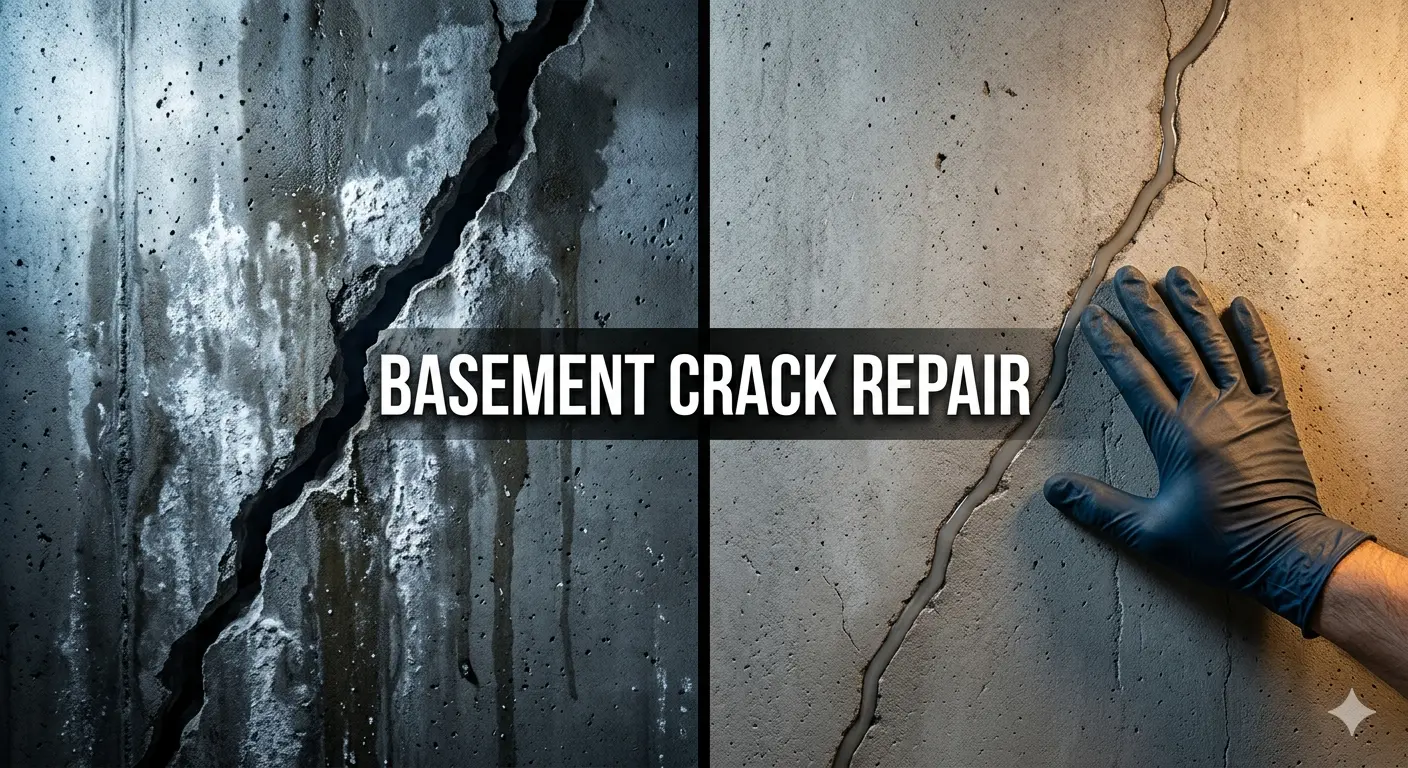
Basement Crack Repair: What Every Kuwait Homeowner Needs to Know
By: By Hussain Al-Mutairi, Kuwait Foundation Repair Specialist with 10+ Years of Hands-On Experience March 19, 2026
If you have found a crack in your basement wall or floor, you are probably doing one of two things right now: quietly panicking, or searching 'basement crack repair near me' hoping someone will tell you it is nothing to worry about.
Here is the truth most guides — and frankly most contractors — will not give you upfront: the crack itself is rarely the problem. The problem is what caused the crack, and whether the person you are about to hire actually fixes that cause or just fills the gap and sends you an invoice.
I have taken over dozens of basement crack repair jobs in Kuwait where a homeowner or a previous contractor had already 'fixed' the crack. In more than 70% of those cases, the earlier repair had either failed completely or — more dangerously — made the underlying problem worse. This guide documents what I have learned from those jobs: the real causes, the right repair methods, the critical warning signs, and the one question you must ask every contractor before you spend a single dinar.
Why Basement Cracks Happen — Understanding the Root Causes
Basement cracks do not appear randomly. Every crack has a cause, and that cause is still active long after the crack first appears. Fixing the crack without addressing the cause is the single most expensive mistake homeowners make.
Concrete Shrinkage During Curing
Most poured concrete walls develop hairline shrinkage cracks within the first year of construction. Concrete loses moisture as it cures, and that shrinkage creates tension in the wall. In Kuwait's extreme summer heat, this process is accelerated — concrete that cures too fast in high temperatures is significantly more prone to early cracking than concrete cured in controlled conditions. These shrinkage cracks are typically the least serious type, but they are also the most commonly misdiagnosed as 'just cosmetic' when they are actually early entry points for moisture.
Foundation Settling and Soil Movement
All structures settle to some degree after construction. Uniform settling — where the entire foundation drops evenly — rarely causes serious damage. The problem is differential settling, where one part of the foundation sinks more than another. In areas across Kuwait City, Salmiya, and Hawalli where older construction sits on variable fill soils or soft ground near the coast, differential settling is a common driver of diagonal and stair-step cracks.
Hydrostatic Pressure from Groundwater
When soil around a foundation becomes saturated — during Kuwait's winter rainfall season or through landscape irrigation — water exerts hydrostatic pressure against the outside of the basement wall. That pressure is the number one cause of leaking basement cracks in the region. Most homeowners assume their basement leaked because of a crack. Often, the sequence is reversed: hydrostatic pressure created the crack, and now water is flowing through it.
Expansive Soils and Seasonal Ground Movement
Kuwait's subsurface includes expansive clay and sabkha soil zones, particularly in coastal and low-lying areas. These soils expand significantly when wet and shrink when dry, exerting lateral and vertical pressure on foundation walls that standard concrete was never designed to resist. Homeowners in areas like Fahaheel, Abu Halifa, and parts of Ahmadi should be especially vigilant — the seasonal expansion cycle in these soil types creates progressive wall movement that worsens over years if ignored.
Poor Drainage, Grading, and Downspouts
This is the root cause that I see behind the majority of basement crack repair jobs in Kuwait — and it is the one that every cheap patch job ignores. Negative grading (ground that slopes toward the foundation), blocked drainage channels, and flat landscaping allow water to pool directly against the wall. Even in a low-rainfall climate, a single irrigation system or a heavy winter storm can generate enough hydrostatic pressure to widen an existing crack by 50% overnight.
Types of Basement Cracks — What Each One Means
Not all basement cracks are equal. The shape, direction, location, and width of a crack tell an experienced eye everything about how serious the situation is and what repair method is actually needed. Getting this diagnosis wrong is the most expensive mistake a homeowner can make.
Vertical Cracks — Common, But Context Matters
Vertical cracks running top-to-bottom are the most frequent type in poured concrete basements. When they are narrow (under 1/8 inch), stable, and dry, they are usually shrinkage cracks — manageable with the right injection material. However, when a vertical crack is wider than 1/4 inch, wet, or has visible mineral deposits (white efflorescence) around it, it is telling you that water has been moving through it regularly under pressure. That is no longer a cosmetic issue.
Horizontal Cracks — The Most Dangerous Type
Horizontal cracks are the most misidentified and most dangerous crack type I encounter. Homeowners routinely call them 'settling cracks' or assume they are cosmetic because they are common. They are neither. A horizontal crack in a basement wall means the wall is under lateral pressure — soil, water, or both are pushing the wall inward from the outside.
Even a hairline horizontal crack demands immediate professional evaluation. Waiting to see if it 'gets worse' is the mistake that turns a KD 500 repair into a KD 5,000 wall stabilization job. I have seen properties in Rumaithiya and Bayan where horizontal cracks that were painted over during a home sale became a structural emergency for the new buyer within two years.
Diagonal Cracks — Differential Settlement
Diagonal cracks running at a 30–45 degree angle from corners of windows or doors typically indicate differential settlement — one part of the foundation is moving faster than another. They are more serious than vertical shrinkage cracks but less immediately dangerous than horizontal cracks if caught early. They almost always require professional diagnosis to determine if movement is ongoing.
Stair-Step Cracks — Block and Masonry Walls
In block or brick foundation walls, cracks follow the mortar joints in a stair-step pattern. These indicate settlement or lateral pressure working through the weakest point of the wall — the mortar. Stair-step cracks in Kuwait's older villa stock, particularly buildings from the 1970s and 1980s, are common and frequently underestimated by homeowners who patch the mortar with surface filler and consider the job done.
Hairline Cracks — Watch, Don't Ignore
Hairline cracks (under 1/16 inch) are the most common and typically the least urgent. However, 'least urgent' does not mean 'ignorable.' In Kuwait's climate, even hairline cracks provide entry points for humidity and moisture that drive interior mold growth — a significant concern in any climate-controlled basement. The rule is simple: monitor them over 6–12 months. If they widen, fill with moisture, or develop efflorescence, they need professional attention.
Structural vs. Non-Structural: The Distinction That Matters
A structural crack affects the load-bearing integrity of the wall. A non-structural crack is a cosmetic or waterproofing issue. Every horizontal crack is structural. Most diagonal cracks are structural. Vertical cracks can be either. Hairline shrinkage cracks are typically non-structural. This classification — not the crack's appearance to an untrained eye — determines what repair method is appropriate and whether an engineer is required.
How to Assess a Basement Crack Before You Repair It
Before calling anyone or buying anything, spend fifteen minutes doing a proper assessment. Most homeowners skip this step entirely and go straight to a hardware store or a contractor. The assessment determines everything — the right repair method, the right professional, and whether you have a KD 50 problem or a KD 5,000 problem.
Warning Signs That Demand Immediate Action
Stop reading, stop researching, and call a structural engineer or foundation specialist today if you observe any of the following:
- Any horizontal crack, regardless of width
- Visible bowing or inward lean of the basement wall (even 1/2 inch is significant)
- A vertical crack wider than 1/4 inch, especially with evidence of water
- Cracks that have visibly widened over weeks or months
- Multiple new cracks appearing after heavy rain or flooding
- Sticking doors or windows on the floor above the basement
- Floors above the basement that feel or measure out of level
- Active water flowing — not seeping, but flowing — through a crack
|
⚠ Critical Warning The industry consistently under-communicates this threshold because clearly stating it can lose a sale to a competitor who will 'just try injection anyway.' I have seen that approach turn KD 800 jobs into KD 15,000 emergencies. If any of the above signs are present, treat it as a structural emergency. |
How to Monitor a Crack Over Time
For cracks that do not trigger the emergency list above, the most useful thing you can do before calling anyone is to monitor the crack. The pencil method is simple and reliable: draw a line across the crack at its widest point, note the date and width, and check it monthly. If the crack is growing — especially after rain — that is active movement, and the repair approach changes significantly.
More accurately, you can use a crack gauge (available at hardware stores in Shuwaikh Industrial Area) to measure width in millimeters and track changes precisely. A crack that grows more than 1mm in three months is considered actively moving and should not be injected without first stabilizing the wall.
When to Call a Structural Engineer vs. a Contractor
Call a structural engineer when: the crack is horizontal or diagonal, the wall shows any bowing, the crack is in a load-bearing section of the foundation, or you are about to sell the property and need documentation. A licensed structural engineer provides an independent assessment with no financial interest in recommending a specific repair product.
Call a waterproofing or foundation repair contractor when: cracks are vertical, non-structural, and you need a repair quote. But — and this is critical — get the structural engineer's assessment first for anything beyond a simple dry hairline crack. Many contractors in Kuwait's market are skilled tradespeople but are not qualified to evaluate structural movement. Asking a waterproofing contractor to assess structural bowing is like asking a plumber to diagnose an electrical fault.
Basement Crack Repair Methods Explained
The repair method must match the crack type, cause, and current condition of the wall. There is no universal solution — despite what most product marketing and many contractor websites will tell you. Using the wrong method is not just ineffective; it actively worsens the outcome.
Polyurethane Foam Injection — Best for Wet, Leaking Cracks
For the majority of basement wall crack repair jobs I handle — especially vertical cracks with active moisture or intermittent water seepage — polyurethane injection is the correct first-line method. Polyurethane foam expands 10 to 30 times its liquid volume, works on wet concrete (unlike epoxy, which bonds poorly to moisture), remains flexible after curing, and permanently seals water migration through the crack. It is the superior tool for Kuwait's most common basement crack scenario: a vertical wall crack admitting water during winter rain or through hydrostatic pressure from irrigation.
Epoxy Injection — The Most Oversold Solution in the Industry
Epoxy is technically the strongest repair material — but it is the wrong choice for most real basement crack scenarios, and it is oversold precisely because it is easy to market as a 'structural' fix. Here is the honest breakdown:
Epoxy is appropriate only when the crack is completely dry, has been stable (no measurable movement) for at least 6–12 months, and the repair goal is restoring structural/tensile strength rather than waterproofing. A load-bearing wall with a static dry crack in a bone-dry basement is an epoxy candidate.
Epoxy is the wrong choice when there is any moisture, when the crack has moved at any point, or when soil pressure is still active. In those conditions — which describe roughly 80–90% of real Kuwait basements — epoxy stays liquid too long, runs out through the back of the crack into the soil, leaves voids, and then cures rigid. Any subsequent wall movement cracks the repair immediately. Worse, the hardened epoxy mass makes professional re-injection of the same crack nearly impossible, turning what should be a KD 100–200 polyurethane job into a KD 800–1,500 remediation.
|
Industry Reality Many companies still default to epoxy because it carries higher margins and is easier to market as 'permanent structural repair.' Experienced waterproofing contractors have largely moved away from epoxy as a standalone basement solution. If a contractor quotes epoxy injection for a damp or leaking vertical crack without first confirming it is fully dry and stable, that is a red flag. |
Carbon Fiber Straps — For Early-Stage Bowing Walls
When a basement wall shows measurable bowing (typically 1/2 to 2 inches of inward movement) but the structural integrity is still sound, carbon fiber straps bonded vertically to the wall can halt further movement. They are not a cure — they do not push the wall back to vertical — but they are a cost-effective way to stabilize a wall that is moving before it reaches the threshold requiring full replacement. Carbon fiber strap installation in Kuwait typically runs KD 400–1,200 depending on wall length and severity.
Wall Anchors and Helical Tiebacks — For Moderate to Severe Bowing
When bowing exceeds approximately 2 inches, or when carbon fiber straps cannot provide sufficient resistance, wall anchors or helical tiebacks driven into the surrounding soil provide active resistance against lateral pressure. Unlike carbon fiber straps, anchors can be gradually tightened over seasons to slowly restore the wall toward plumb. This is a professional-only installation and should always be accompanied by addressing the exterior drainage issue that caused the pressure.
Interior Drainage Systems — For Chronic Water Entry
When water entry is chronic — not just from a single crack but from multiple points or through the floor-wall joint — a perimeter interior drainage system (channel drain + sump pump) addresses the symptom at the drainage level rather than trying to stop water at every individual entry point. In Kuwait homes where exterior excavation is impractical or where hydrostatic pressure is consistently high, interior drainage is often the most reliable long-term solution, particularly in older villas in areas like Jabriya or Rumaithiya.
Exterior Waterproofing and Excavation
The most comprehensive and longest-lasting solution is exterior excavation — digging down to the foundation footing, applying a waterproof membrane to the outside face of the wall, and installing a drainage layer and drain tile to redirect water away from the foundation. It is also the most expensive option (KD 2,000–8,000+ depending on wall length and depth) and is typically only warranted when interior methods have failed or when a home is undergoing major renovation. In Kuwait, exterior excavation in dense residential neighborhoods requires coordination with municipal authorities.
DIY Basement Crack Repair — What You Can and Cannot Do
Cracks You Can Safely Repair Yourself
Narrow (under 1/8 inch), dry, stable hairline cracks that have shown no change over 6 or more months can be addressed with a DIY approach. Surface sealing with a polyurethane caulk or a vinyl concrete patching compound available at hardware stores in Shuwaikh or Fahaheel will prevent moisture ingress and keep the crack from widening due to dust and debris accumulation.
The Preparation Step Every DIY Guide Skips
This is the single detail that separates a 2-year repair from a 20-year repair: fixing the external water and pressure source before touching the crack. Not cleaning the crack — that is basic. The skipped step is confirming that the crack is no longer under active hydrostatic pressure and that the root cause has been corrected.
Practically, this means: check that ground around the foundation slopes away at a minimum 6-inch drop over 10 feet, that downspouts discharge at least 10 feet from the foundation, that irrigation heads are not pointed at the wall, and that any pooling areas near the basement are graded or drained. When these conditions are met first, even a basic injection repair routinely lasts 20–30 years. When they are ignored, even a professional-grade injection fails within 1–5 years.
Cracks That Require a Professional
Do not attempt DIY repair on any of the following:
- Any horizontal crack
- Any crack with visible water flowing through it
- Any crack wider than 1/4 inch
- Any crack accompanied by wall bowing or floor heave
- Stair-step cracks in block or brick walls
- Any crack in a load-bearing section of the foundation
The Hidden Cost of a Failed DIY Repair
In my experience taking over DIY repair jobs, the pattern is consistent: a homeowner spends KD 30–60 on a store-bought epoxy injection kit, applies it to a damp or slowly leaking vertical crack, and the crack appears sealed for a few months. Then water returns — often at a different location 2–3 feet from the original crack, because the hardened epoxy has redirected the pressure path. Now the wall is damp over a wider area, potentially trapping moisture inside the wall structure and accelerating concrete spalling and mold growth behind any finished wall surfaces.
The repair that was supposed to cost KD 30 now costs KD 800–1,500 for professional remediation — because the hardened epoxy mass prevents re-injection and the contractor must approach it differently. I have seen this exact sequence damage finished basement spaces in Kuwait worth many times the cost of the original proper repair.
What Happens During a Contractor's First Visit (And What They're Not Telling You)
Most homeowners think a contractor's first visit is a straightforward quote. It is not. Here is what an experienced foundation specialist is actually evaluating the moment they walk into your basement — and what is running through their mind before they give you a number.
The Silent Structural Assessment
Before they say a word about injection or repair methods, a good contractor is running a mental checklist:
- Measuring wall bow — a straightedge or laser level against the wall face. Even 1/2 inch of inward movement changes the entire repair approach from injection to stabilization.
- Reading the crack pattern — width, length, whether it is wider at the top or bottom, and whether there is evidence of recent widening (fresh concrete dust, new efflorescence).
- Checking for secondary symptoms upstairs — sticking doors, uneven floors, ceiling cracks — that confirm whether this is a local cosmetic issue or a whole-building movement problem.
- Mapping water patterns — not just where the crack is, but where efflorescence, mold, and staining concentrate. These tell the story of where water has been moving and under how much pressure.
- Assessing the foundation type — poured concrete versus block versus older masonry — because the repair approach differs significantly.
The Unspoken Calculation
Within a few minutes of walking in, a contractor has mentally categorized your job into one of two buckets: 'simple injection' (KD 150–400, quick job, low risk) or 'full system' (KD 1,500–6,000+, involves drainage, anchors, or excavation). The quote you receive depends heavily on which bucket your job falls into — but also on whether that contractor is willing to tell you the truth about which bucket it is.
Here is the honest version: contractors who quote injection on a job that needs anchors are not always dishonest — sometimes they genuinely believe the simpler approach will hold. But the financial incentive to quote the cheaper job and win the work is real. Contractors who tell you upfront that your horizontal crack needs anchors, not injection, are the ones worth hiring. They are giving up a quick cheap job to tell you the truth about a more expensive one.
|
Homeowner Tip Ask every contractor this specific question: 'Is this crack a symptom of an ongoing movement or pressure issue, or is it a static historical crack?' Their answer — and their reasoning — tells you whether they have actually assessed the root cause or are just quoting the repair. |
Basement Crack Repair Cost Breakdown
The following cost ranges are estimates applicable to Kuwait's repair market. Actual costs vary based on wall length, crack depth, access difficulty, and whether the root cause (drainage, grading) also requires remediation.
|
Crack Type |
Severity |
DIY Cost (KWD) |
Pro Cost (KWD) |
|
Hairline shrinkage |
Low |
10–25 |
40–80 |
|
Vertical (dry) |
Low–Med |
25–60 |
80–200 |
|
Vertical (leaking) |
Medium |
Not recommended |
150–400 |
|
Diagonal |
Medium |
Not recommended |
200–600 |
|
Stair-step (block) |
High |
Do not DIY |
500–1,500 |
|
Horizontal / bowing |
Critical |
Do not DIY |
1,500–6,000+ |
Factors That Affect Your Final Cost
- Foundation type: Block and masonry walls are more complex and expensive to repair than poured concrete.
- Number of cracks: Multiple cracks on the same wall may indicate systemic pressure — each additional crack adds cost but also suggests the root cause fix is more urgent.
- Finished vs. unfinished basement: If the crack is behind a finished wall, demolition and reconstruction adds significant cost.
- Drainage remediation: If grading, gutters, or exterior drainage also need correction (which they usually do), budget an additional KD 100–500 for this work.
- Location in Kuwait: Jobs in dense urban areas like Salmiya or Kuwait City center may carry access surcharges; jobs in outlying areas like Wafra or Kabd may carry travel premiums.
Does Building Insurance Cover Basement Crack Repair in Kuwait?
Generally, standard building insurance in Kuwait does not cover basement crack repair unless the damage is caused by a sudden, accidental event (such as a burst pipe causing flooding). Gradual settling, hydrostatic pressure, and soil movement — the causes behind most foundation cracks — are typically classified as maintenance issues and excluded from coverage. Check your specific policy and confirm with your insurer before assuming coverage.
How to Prevent Basement Cracks from Returning
The most effective waterproofing system in the world fails if the conditions that created the crack are still present. Prevention is not glamorous work — it is grading, gutters, and drainage. But it is the only thing that makes any repair last.
Fix the Grade Around Your Foundation
The ground immediately surrounding your home should slope away from the foundation at a minimum gradient of 6 inches drop over the first 10 feet. In Kuwait's older residential areas — particularly villas where landscaping has been modified over decades — negative grade (sloping toward the house) is extremely common and is the single most frequent root cause I see behind recurring crack repairs. Re-grading with compacted fill costs very little compared to the repairs it prevents.
Downspout Extensions and Drainage Channels
Every downspout that discharges within 3 feet of the foundation is directing roof runoff directly at your basement walls during Kuwait's winter rains. Extending downspouts to discharge at least 10 feet from the foundation, or connecting them to underground drain lines that daylight well away from the structure, removes a primary water source from the foundation zone.
Waterproofing Options After Repair
Once cracks have been properly repaired and drainage corrected, interior waterproofing coatings (crystalline products or elastomeric membranes applied to the inside face of the wall) add a secondary barrier against residual moisture vapor. These are maintenance-level products — they do not replace proper drainage — but they extend the life of the repair and protect against minor humidity infiltration in Kuwait's seasonally variable climate.
Annual Inspection Schedule
The five-minute annual inspection that prevents expensive repairs: in October before Kuwait's rain season begins, walk the perimeter of your home and check that grading still slopes away from the foundation, downspouts are clear and discharging away from the house, no landscaping has been added against the foundation wall, and basement walls show no new cracks or widening of previously monitored cracks. Five minutes every year is worth more than any single repair job.
Frequently Asked Questions About Basement Crack Repair
How do I repair basement wall cracks myself?
For dry, stable hairline cracks under 1/8 inch, clean the crack with a wire brush and vacuum, apply a polyurethane backer rod if the crack is wide enough, and seal with a polyurethane caulk rated for masonry. For narrow shrinkage cracks, a vinyl concrete patching compound works well. Do not attempt DIY repair on any crack with moisture, any horizontal crack, or any crack wider than 1/4 inch. Always fix the external drainage issue first.
How do I repair a crack in a basement wall that is leaking?
A leaking crack should not be DIY-repaired with store-bought epoxy kits. The correct professional approach is polyurethane foam injection — it bonds to wet concrete, expands to fill voids, and remains flexible. Before any injection is done, the external water source (grading, downspouts, hydrostatic pressure) must be identified and corrected. A repair on an actively pressurized crack without addressing the source will fail within months.
How do I repair cracks in a basement floor?
Basement floor cracks fall into two categories: shrinkage cracks (very common, typically non-structural, treatable with polyurethane caulk or self-leveling sealant) and structural floor cracks (caused by soil heave or settlement, which require professional evaluation). Floor cracks that are wider at one end, that have vertical displacement (one side higher than the other), or that are accompanied by wall cracks should be assessed by a professional before any repair attempt.
How do I repair cracks in basement walls — poured concrete vs. block?
Poured concrete walls: polyurethane injection (for wet/leaking cracks) or epoxy injection (for dry stable structural cracks) are the standard methods. Block (CMU) walls: injection is rarely effective because mortar joints distribute pressure across multiple failure points. Block walls typically require tuckpointing (repointing the mortar joints), wall anchors for lateral movement, and interior drainage for chronic moisture. The repair approach differs fundamentally between the two wall types — a contractor experienced with one is not necessarily experienced with the other.
Are all basement cracks dangerous?
No. Hairline shrinkage cracks in poured concrete walls are extremely common and typically non-structural. The dangerous cracks are horizontal (lateral pressure), rapidly widening cracks (active movement), and cracks accompanied by wall bowing or floor displacement. The direction and width of the crack — not just its presence — determines urgency.
How long does a professional basement crack repair last?
A professional polyurethane injection on a vertical non-structural crack, combined with correction of the external drainage root cause, routinely lasts 20–30 years. Without the drainage correction, the same repair lasts 1–5 years before water finds a new path. Structural repairs (anchors, piers) come with manufacturer warranties of 25 years to lifetime when properly installed.
Can I finish my basement after repairing a crack?
Yes, but not immediately. After injection repair, allow at least 30–60 days to confirm no recurrence before installing any finished wall surfaces. Finishing over an unmonitored crack — particularly in Kuwait's humid winter months — risks trapping moisture, creating a mold environment behind the drywall. Monitor the repair through at least one full rain season before committing to finish work.
How do I find a qualified basement crack repair contractor near me in Kuwait?
Ask specifically for contractors who offer polyurethane injection (not exclusively epoxy), who can show you previous work with before/after documentation, and who will assess the external drainage situation as part of their evaluation — not just the crack itself. Request a written scope that identifies the cause of the crack, not just the repair method. A contractor who cannot explain what caused your crack should not be trusted to fix it permanently.
The Bottom Line
Basement crack repair in Kuwait is not complicated — but it is misunderstood at almost every level of the market, from big-box hardware stores selling DIY epoxy kits to contractors who quote injection on walls that need anchors.
The decision tree is actually simple: identify the crack type, determine whether the external cause is still active, match the repair method to the crack condition (not to the product someone is trying to sell you), and verify the drainage before the repair goes in.
The most expensive words in basement repair are 'I already tried to fix it.' Do it once, do it right, and fix the drainage first.
— Based on field experience from basement crack repair and foundation waterproofing work across Kuwait, including Kuwait City, Salmiya, Hawalli, Rumaithiya, Bayan, Jabriya, Fahaheel, and Ahmadi.